

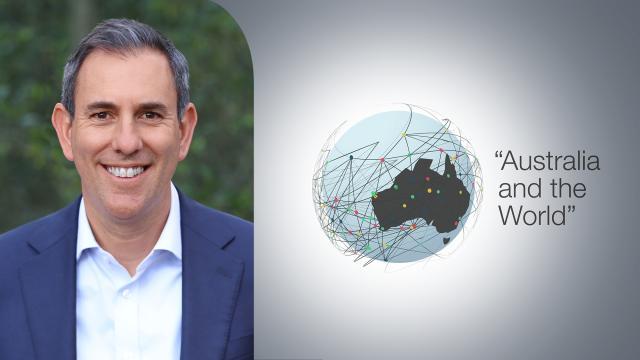
Jim Chalmers has put the right question at the centre of Australia’s economic debate: how do we make the changes ahead improve people’s lives? His speech accompanying the 2026 Intergenerational Report deserves a broadly positive reception because it connects long-term economic planning with the insecurity Australians experience now. Its credibility will ultimately depend on whether the government turns that connection into results.
Delivering the Australia and the World Annual Lecture at the Australian National University on 21 September, the Treasurer outlined an Australia reshaped by artificial intelligence, cleaner energy, an ageing population and a more uncertain international environment. He presented these changes as challenges governments can influence through decisions taken today. [1]
That is a useful starting point. A forty-year report cannot settle the future, but it can expose the consequences of avoiding difficult decisions. Housing, workforce skills and energy infrastructure take years to change. Waiting until the pressures become overwhelming would make those choices more expensive and less fair.
The strongest part of Chalmers’ argument was his recognition that economic exclusion can weaken confidence in democracy. People who work hard yet struggle to secure a home or plan a family have good reason to question whether national prosperity includes them. A larger economy will mean little politically if too many Australians cannot see a workable future within it.
There was also familiar political overstatement. The claim that Australia is better prepared than its peers in almost every respect is the Treasurer’s assessment, not a conclusion established merely by releasing an Intergenerational Report. His tendency to divide the debate between those alleviating insecurity and those exploiting it leaves too little room for legitimate disagreement. A confident reform agenda should welcome scrutiny of its assumptions.
The promise behind the projections
The report projects average annual real economic growth of 2 per cent over forty years, with real national income per person about 55 per cent higher by 2065–66. These are encouraging possibilities. They need to be understood accurately. [2]
The income measure is real gross national income per person: a national average, adjusted for inflation. It does not promise that every worker’s pay, or every household’s disposable income, will rise by 55 per cent. How prosperity is shared will depend on wages, housing costs, taxes, public services and access to assets. An average can improve while particular groups remain under considerable pressure.
Nor are forty-year projections predictions with the certainty of a timetable. They describe what follows from a set of assumptions. Their value lies partly in helping us ask what happens if productivity disappoints, participation changes or public services cost more than expected. The government should make those alternative paths as easy to understand as the central outlook.
This matters especially for artificial intelligence. The report retains the long-run labour-productivity growth assumption of 1.2 per cent a year used in the 2023 report. Expected AI benefits help inform that assumption; AI is not an additional 1.2 per cent bonus layered on top. [2]
Chalmers was sensible to emphasise better ways of working. Buying software or building data centres does not, by itself, demonstrate that Australians are producing more valuable work. The useful questions are whether a small business can serve customers better, whether a clinician can spend less time on paperwork, and whether public administration can become more accurate and accessible.
Policy should therefore put practical adoption alongside infrastructure investment. Workers need paid opportunities to learn, a say in how systems change their jobs, and clear routes to human review when automated decisions affect them. Businesses need reasons to improve services and develop skills, rather than simply reduce headcount. Occupational exposure estimates cannot guarantee anyone’s job security.
For Australians, the sensible response is to build familiarity with these tools while expecting employers and government to share responsibility for the transition. Individuals should not have to carry every risk associated with a technology promoted as a national economic opportunity.
Making change work for households
Energy offers another example of a promising direction that requires careful explanation. The report describes a scenario in which average household energy expenditure falls by about 40 per cent in real terms between 2030 and 2050, conditional on electrification proceeding at the projected rates. That covers petrol, gas and electricity together. It is not a promise that everyone’s electricity bill will fall by 40 per cent. [2]
The opportunity is substantial. The policy question is how households gain access to it. A homeowner able to replace appliances or buy an electric vehicle faces different choices from a renter whose landlord controls the equipment, or a family unable to meet the upfront cost.
An effective transition should therefore include rental homes, apartments and households with limited savings. It also needs reliable generation, storage and networks. Growing electricity demand from data centres makes coordination more important: new investment should help fund the capacity it requires, with transparent consideration of water use and local impacts. Australians should expect the transition to be judged by reliability and total household costs as well as investment announcements.
Demography requires a similarly practical approach. Chalmers was right to treat longer lives as an achievement and to recognise that decisions about children belong to individuals and families. In the question-and-answer session, he explicitly rejected telling people whether or when to start a family. His emphasis on making that choice easier was welcome. [3]
The projection that deaths will exceed births in the 2060s should not become a slogan about national decline. It describes natural population change. The report still projects total population growth under its migration assumptions. [2] The useful response is to plan housing, services and infrastructure around plausible population paths, while helping people pursue the family lives they actually want.
Migration can contribute skills and working-age people, but it should sit alongside domestic training and credible infrastructure planning. The debate becomes more useful when governments explain how population settings fit with homes, transport and services. Blaming migrants for every shortage avoids the decisions responsible governments must make.
Housing is where the intergenerational argument becomes particularly concrete. In the questions after his speech, Chalmers declined to nominate a home-ownership target. [3] That does not establish that the government lacks a housing policy. It does leave a fair question about how Australians should judge progress.
Home ownership can offer security, but policy should also make renting a stable and dignified option. Governments should publish clear measures of housing affordability, rental security, access to social housing and the delivery of well-located homes. A young person should be able to see whether their prospects are improving before waiting decades for a national average to confirm it.
There are differences within generations too. An older renter and an older homeowner may face very different retirements. A younger person supported by family wealth may have advantages unavailable to someone earning the same wage without that help. Intergenerational fairness should take those differences seriously.
A budget that still requires choices
Chalmers also argues that the fiscal outlook has improved since the previous report. The comparison needs its proper units. Commonwealth government spending is projected to rise from 26.6 to 27.7 per cent of GDP over the report’s horizon: an increase of 1.1 percentage points of GDP. That is not a claim that spending in dollars will rise by only 1.1 per cent. [2]
A better projected budget position is welcome, but it does not remove difficult choices. Treasury attributes most of the improvement since 2023 to lower projected payments relative to the size of the economy. The report still projects an underlying cash deficit at the end of the period. [2] Its results depend on assumptions about economic performance, revenue and the future cost of services. Governments should keep these contributions visible in regular updates and explain what they would do if the assumptions fail.
Care deserves particular attention. Sustainable funding matters because people need services they can rely on over time. Yet a lower spending trajectory does not establish that an older person receives adequate care or that a disabled person has the support needed to participate in daily life.
When discussing aged care and the NDIS, fiscal reporting should therefore sit alongside evidence about access, quality, unmet need and pressure on unpaid carers. These are distinct systems serving different needs. Both require an account of what reform means for the people using them, beyond its contribution to the budget.
Tax policy also needs an honest explanation. The report’s 24.2 per cent tax-to-GDP limit is a technical modelling assumption applying from 2032–33. It is not a legislated ceiling or a schedule of future tax cuts. [2] Chalmers explained in the questions that it reflects an assumption about governments returning bracket creep when they can afford to do so. [3]
That is a reasonable subject for modelling and political debate. It cannot resolve how future governments should balance taxes on work and assets, fund essential services or distribute the cost of ageing. Those decisions should be argued openly, with their effects on different households made visible.
What Australians should expect
The practical next step is a modest, public set of measures connecting the report to decisions made each year. Australians should be able to track whether housing becomes more accessible, whether energy costs fall across different household types, whether care remains available and whether productivity gains improve pay and services. Reporting should show who benefits and who is being left behind.
Government should also explain when outcomes diverge from the report’s assumptions and what it intends to change. Treasury’s projections cannot bind governments for forty years, but they can support more accountable decisions now. Businesses, unions, communities and state governments all have a part in that work.
My reading of Chalmers’ speech is cautiously positive. He is asking the right broad questions and making a credible case for preparation. The emphasis on opportunity, household security and the choices facing younger Australians deserves support. The evidence does not justify treating the government’s entire programme as proven, and support should remain conditional on delivery.
Australians can take a measure of confidence from this outlook while expecting much more than reassuring projections. The real achievement would be an Australia in which a longer life comes with adequate support, technological change improves working life, and a younger person can plan a secure future. Chalmers has described a direction worth pursuing. The next test is whether people begin to experience it.