

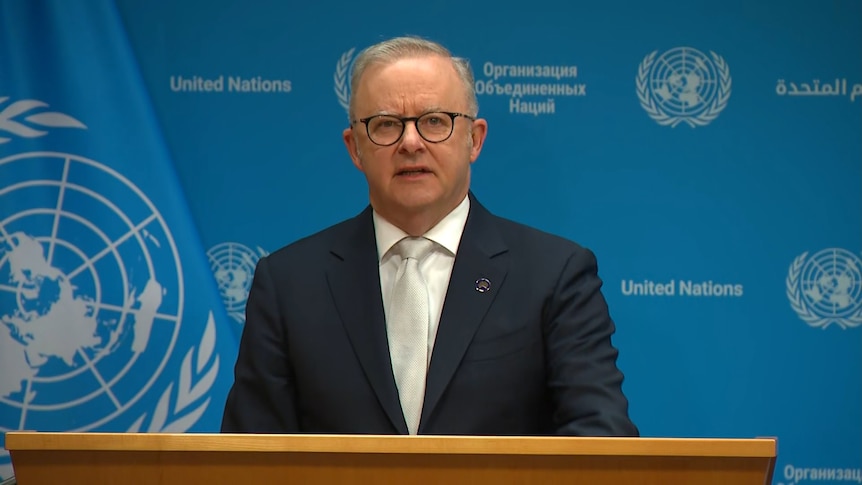
Anthony Albanese is broadly on the right path in arguing that Australia needs to help shape the international decisions that affect our lives. His case deserves a fair hearing. The useful question now is how his government will turn that ambition into practical results, and how Australians will be able to judge its performance.
The remarks reviewed here came from his New York press conference, officially dated 21 September 2026, during the United Nations General Assembly period. This was the launch of Australia’s campaign for a non-permanent Security Council seat in 2029–30, rather than the formal General Assembly address. The election is scheduled for June 2028. [1, 2]
That distinction matters when judging the detail. A press conference can establish a direction and test a leader’s reasoning; it cannot reasonably contain an entire foreign policy programme. On that basis, I found the direction encouraging, even where the answers needed more substance.
The strongest part of Albanese’s argument was his connection between international instability and everyday Australian concerns. Foreign policy can seem distant until an overseas disruption changes the price of getting to work, moving goods or running a business. Explaining that connection is a worthwhile part of a prime minister’s job.
There is an economic basis for it. The Reserve Bank’s May 2026 analysis explains how higher global energy prices can raise Australian inflation and squeeze household purchasing power. Australia exports substantial energy resources, but imports much of the refined fuel on which transport and industry depend. Some exporters can benefit from higher prices while households and other businesses face greater costs. The national picture is therefore more complicated than saying that every Australian loses in the same way. [3]
For Australians, the implication is that domestic resilience and diplomacy should reinforce each other. Reliable fuel supplies, efficient transport and a more diverse energy system remain practical priorities at home. International cooperation can help address some of the conditions that create disruption. Neither makes the other unnecessary.
This is where the case for engagement is persuasive. The case for a particular Council seat needs an additional explanation: what would membership enable Australia to do better than it can already do through its existing relationships and institutions?
The answer begins with the powers of the institution. An elected member has a vote and participates directly in the Council’s work. It does not acquire a veto. Substantive decisions generally require at least nine affirmative votes without a veto from a permanent member; a permanent member’s abstention need not prevent adoption. [4]
The practical opportunity is to help develop proposals, negotiate support and keep attention on issues that might otherwise receive less of it. That opportunity can be valuable. It also depends on the cooperation of other governments, some of which may have sharply different interests. Australians should not be promised that winning a seat will itself end wars or lower the weekly shopping bill.
Albanese’s reference to MH17 offered a useful example of what membership can make possible. Australia authored Security Council Resolution 2166, adopted unanimously in July 2014, supporting an international investigation, access to the crash site and accountability. [5] It was a substantial diplomatic contribution in circumstances Australia had not been able to predict when seeking its previous term.
Preparedness is a reasonable argument. Governments routinely build capacity before knowing exactly when it will be needed. Diplomatic relationships and institutional experience can have that kind of value too.
The qualification is that countries outside the Council are not powerless. Article 31 of the UN Charter allows a UN member outside the Council to participate without voting when the Council considers its interests specially affected. [6] MH17 illustrates the potential usefulness of membership; it does not prove that every Australian contribution would otherwise have been impossible.
There is also a longer national story behind this campaign. Julie Bishop announced Australia’s nomination for the same 2029–30 term in September 2015. [7] That continuity makes this a national initiative with a history across governments, while leaving its present merits open to scrutiny.
The published campaign deserves more credit than a reading of the press conference alone might suggest. The government has identified conflict prevention, ocean and climate security, digital futures and the participation of smaller states as priorities. DFAT’s campaign material goes further, proposing stronger early warning, preventive diplomacy, peacebuilding and humanitarian protections. [2, 8]
These are credible areas for an Australian contribution. Early warning and prevention offer a practical purpose for diplomacy before a crisis becomes a military or humanitarian emergency. Climate and ocean security provide a basis for working with Pacific neighbours on matters they identify as important. Attention to emerging technology recognises that future security problems will not all arrive in familiar forms.
The next step should be to make those priorities specific enough to assess. On prevention, Australia could identify the proposals it intends to advance and the partnerships needed to support them. On regional representation, it should show how consultation changes its agenda. Pacific countries have their own governments and priorities; Australia should earn their confidence through useful cooperation and avoid assuming that it automatically speaks for them.
Digital policy needs similar precision. Cyber operations and some uses of artificial intelligence raise international peace and security questions. Many other matters belong with domestic regulators, technical bodies or different international forums. A serious Australian agenda should explain which problem it is trying to solve, which institution can act and what safeguards will protect the people affected.
I would apply that discipline to the child safety discussion as well. Expecting technology companies to do more can be justified without assuming that their knowledge of users automatically produces accurate, proportionate age assessment. The policy test should include effectiveness, privacy and the treatment of people incorrectly excluded. These are standards I would want Australia to bring to its technology policy, rather than achievements established by the press conference.
Reform of the Security Council is another area where ambition needs a realistic route. Under Article 108, Charter amendments require approval by two-thirds of the General Assembly and ratification by two-thirds of UN members, including all five permanent Council members. [9] An Australian elected term cannot bypass that barrier.
That still leaves room to pursue improvements in working practices, consultation and transparency while arguing for longer-term structural reform. The government should distinguish what it hopes eventually to change from what it believes it can advance during a two-year term. Doing so would make the reform argument more credible.
Australia’s credibility also depends on how consistently it applies the principles it advocates. Support for sovereignty, civilian protection and international law should guide our treatment of allies and adversaries alike. The campaign’s stated principles are coherent; this review does not establish that every Australian policy decision already meets them.
The questions about Indigenous Australians exposed a domestic part of that test. The Australian Human Rights Commission has reported UN concerns about the treatment of Indigenous children in detention and called for coordinated action. [10] Those concerns deserve clear responses. They do not require Australia to abandon international advocacy, but they do require us to take scrutiny of our own performance seriously.
Celebrating First Nations cultures and acknowledging disadvantage are entirely compatible. The stronger response is to involve the people affected, explain responsibilities across governments and report outcomes. Describing programmes can be useful, but it cannot by itself demonstrate that conditions have improved. Nor should a question left unanswered at a press conference be treated as proof that no relevant policy exists.
The same fairness should apply to the political debate. Questions about cost, influence and measurable outcomes are legitimate. Supporting Australia’s international role does not require accepting every ministerial answer. Equally, dismissing diplomatic work because it is less immediately visible than a local service overlooks the risks governments are expected to anticipate.
My preference would be for a short public plan setting out the campaign’s expenditure, the resources required for a Council term and a small number of intended outcomes. Annual reporting should explain what Australia proposed, what support it secured and what changed. It should also acknowledge setbacks and the limits of attributing a shared diplomatic result to one country.
These are my recommendations for strengthening the campaign, not commitments I am claiming the government has already made. Some useful work will be difficult to measure, particularly successful prevention. That is a reason to choose indicators carefully, rather than to substitute counts of meetings for evidence of progress.
The strongest objection remains the opportunity cost. Could Australia achieve more by putting the same diplomatic effort into other relationships or institutions? The government should answer that openly. A seat is worth pursuing if the contribution Australia can make justifies the resources and the trade-offs involved.
My assessment is cautiously positive. Albanese has made a sensible case for a country willing to participate, build support and accept some responsibility for the international conditions on which it depends. Australians can welcome that direction while expecting clearer commitments and honest reporting. The campaign will become more persuasive as the government shows what it intends to do with the opportunity.